The ultimate guide to everything I know about designing and knitting scale mail gloves!
Having collected years of experience with, and questions about, them, I have compiled everything I could
reasonably fit into this comprehensive guide.
If you are not sure about the difficulty, you may want to start with my Beginner Scale Mail Gloves
pattern which is tailored for absolute beginners.
If you start with the beginner pattern in your Ravelry library, an automatic discount will deduct the price of the
beginner pattern from the ultimate version in the future. If your beginner pattern is not attached to a ravelry account and you
want to upgrade, contact craftymutt-info@yahoo.com and I can set you up with a manual discount code for your platform of choice.
Contents
- 91 page PDF (English)
- ~10 pages covering design options and methods
- 12 pre-written patterns, each in three lengths up to full arm length
- Custom pattern writing tool
- Creates any size or length
- Dynamic materials list for your design
- Option for scales on back of arm, or all around
- Lots of photos, design tips, and charts
- Greyscale print friendly photo-free pattern and chart pages
Characteristics
- Knit in the round
- Shaping with increase/decrease to fit arm
- No sew
- Uses the Purl Scale Stitch (see free tutorial)
What is a Custom Pattern Writing Tool?
It's a self writing pattern spreadsheet!
Unfortunatly in a PDF space is limited by practicality. Even with only three sizes, the written out pattern for the gloves fills nearly 100 pages in order to cover various options that are too different from each other to combine.
I want to be able to provide a far greater range of sizes, among other choices, and from this my glove pattern writing spreadsheet was created. Two versions, one for Microsoft Excel, and one for Libre Office which is open source and free, are included, so note that the format may look slightly different based on file type and version number.
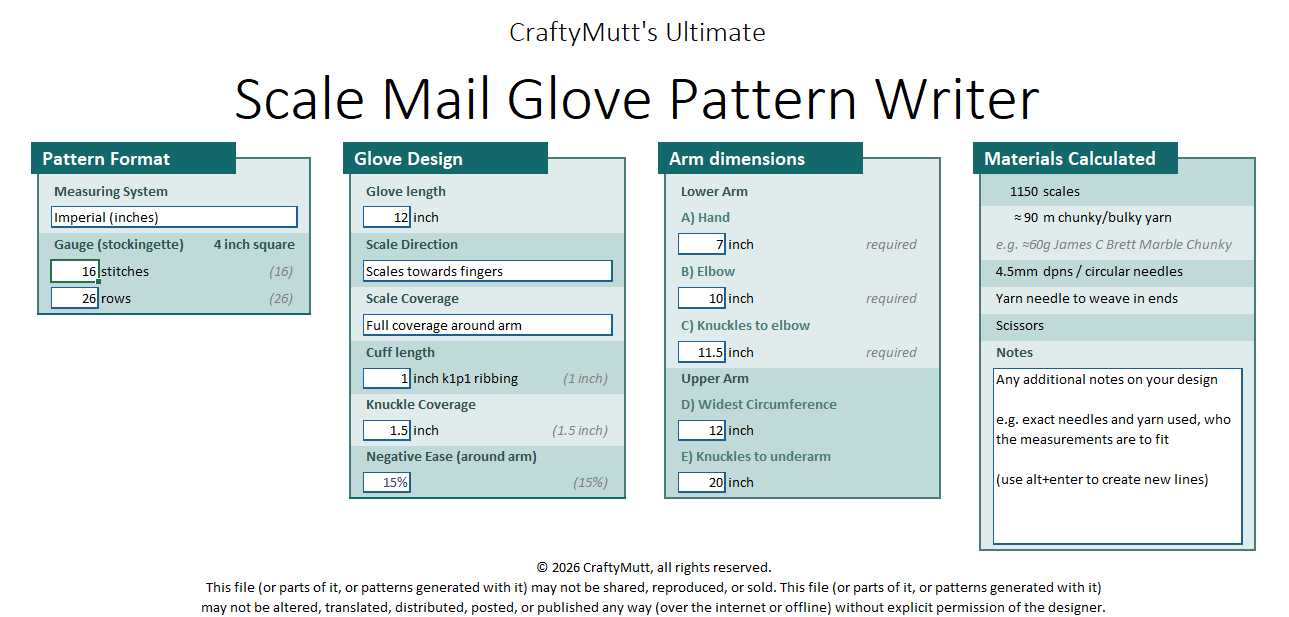
Input your own unique set of measurements and design choices...
The first tab that the spreadsheet begins on is the customiser tab, shown above. This tab captures all of the measurements and choices of your own personal design.
Note that there are extra features here too over what can be achieved in a static pattern;
- Choose your measuring system
- Input your exact gauge for a more precise fit
- Modify the length of the cuff
- Adjust the thumb position for more or less knuckle coverage
- Loosen or tighten the negative ease to your preference
The final column displays a summary of materials for the current design, with space for notes.
Once you have input your design data and are happy, you can check your result in the knitting pattern tab.
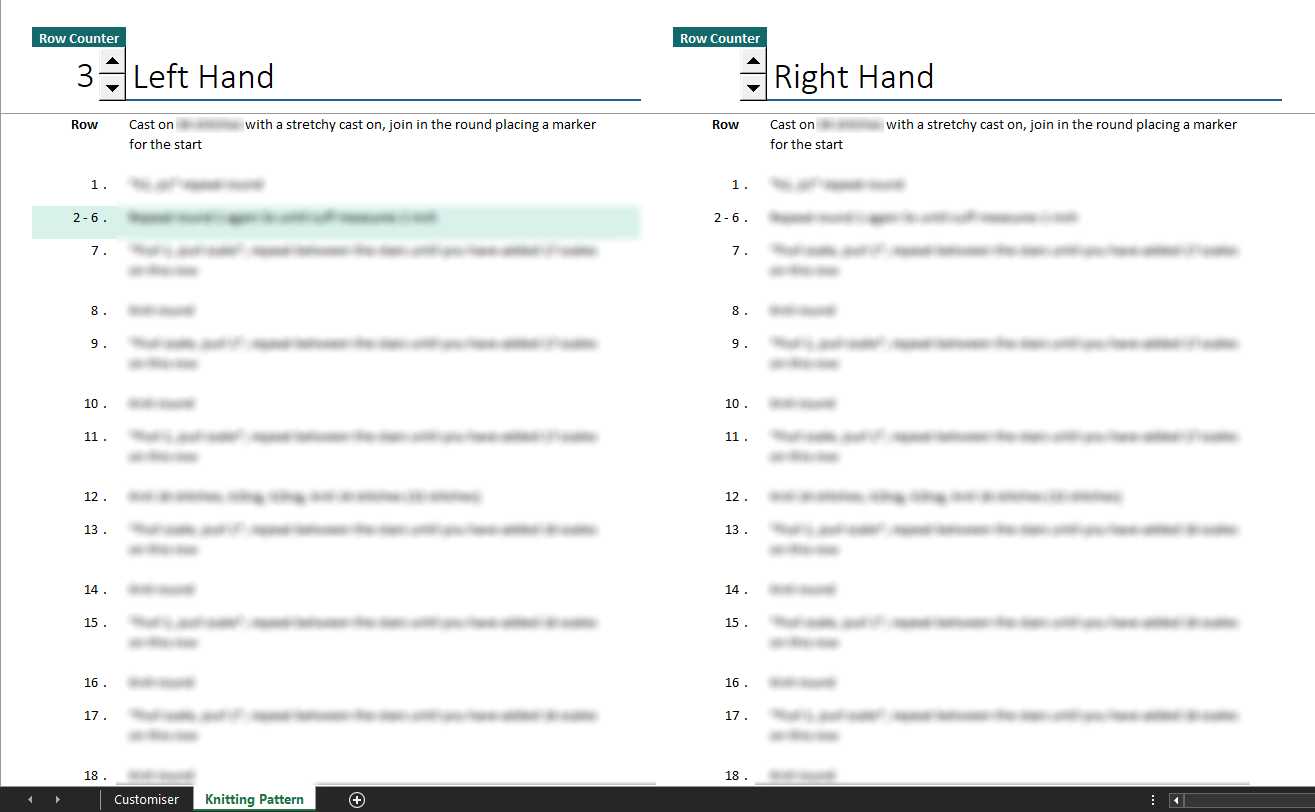
...get your own unique pattern!
The pattern tab shows both arms side by side, similar to how they are arranged in the PDF. This sheet dynamically adjusts a pattern fully written out line by line to match your design! You can continue to adjust the inputs and see the changes to your own custom pattern in real time.
Working all the maths and getting it all output into proper readable sentences was a lot of work, but the result is a pattern that can be made to fit an unprecedented range of sizes without becoming thousands of pages long!
Even if you are working one of the pre-written pattern combinations from the PDF, if you personally prefer not to have to keep track of all the repeating sets of rows or where you need to skip from and to, you may also benefit from the spreadsheet as it writes every line out in full, with no repeats or skips to worry about.
Materials Required
- Small Scales
- Imperial size: 9/16” x 7/8” with a 0.22” hole
- Metric size: 14.3mm x 22.2mm with a 5.6mm hole
- All examples shown made with small scales from theringlord.com (Canada)
- Most examples are annodised aluminium, though some use engineered plastic
- Bulky/Chunky weight yarn
- Look on the ball band for a gauge of 14 stitches, 20 rows with 6mm needles
- You will be working with smaller needles at a tighter gauge than this!
- If you prefer lighter, more flexible gloves, aran or even worsted yarn can be substituted with appropriate needles to maintain pattern gauge
- Many examples shown made with James C Brett Marble Chunky
The quantity of materials needed varies considerably based on the knitter's design choices, check the pattern preview for guidance.
Previews
The exact content of the pages may vary slightly depending on version and place of purchase